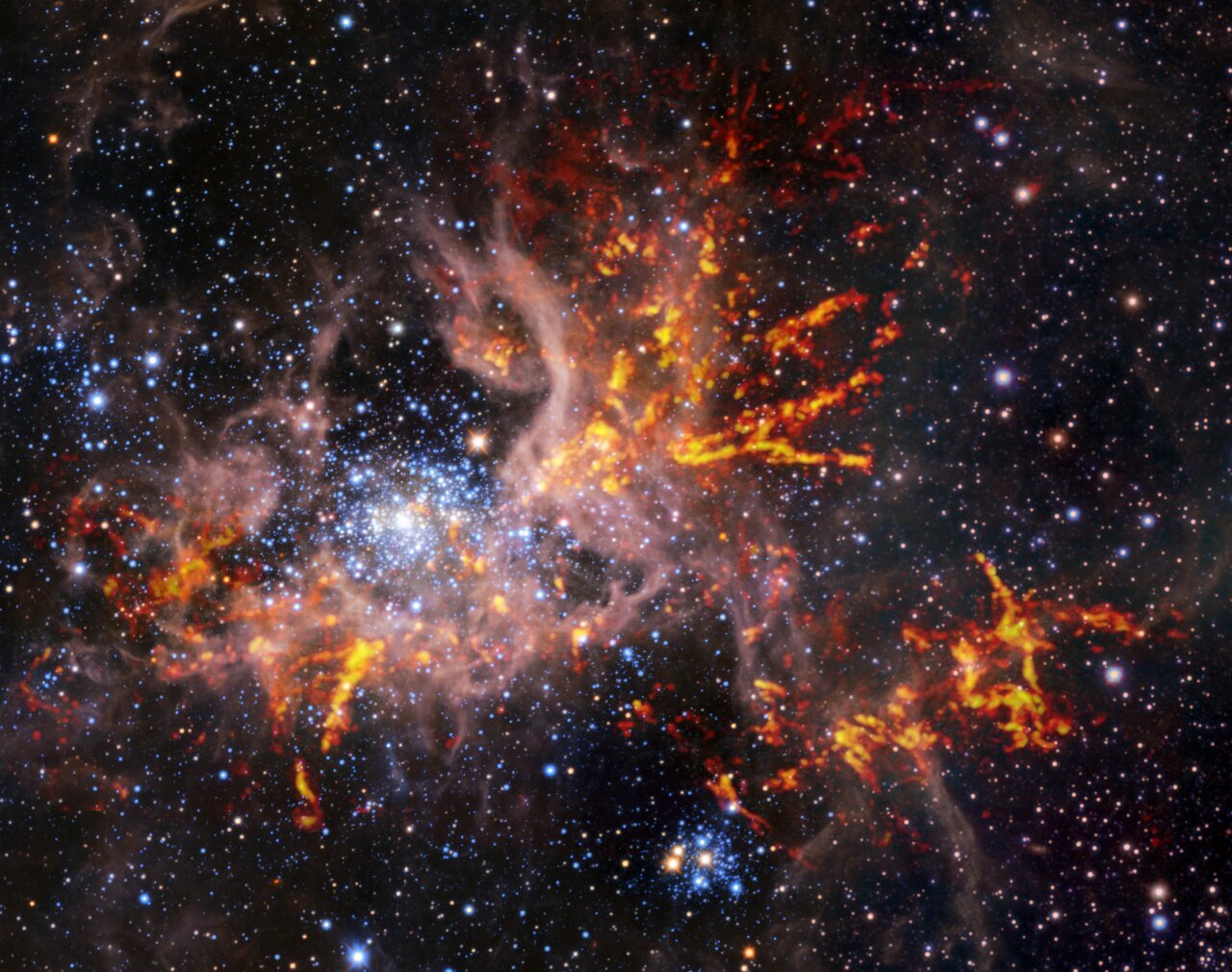
When people imagine astronomy, they often picture a lone star shining calmly for billions of years. That picture is comforting — and for many stars, it’s not too wrong.
But for massive stars (the ones that end their lives as spectacular supernovae and seed the Universe with heavy elements), the “lone star” story is often the exception. A huge fraction of them are born with a partner. And that partnership changes everything.
If you’re new to this blog: I’m an astronomer working on massive stars, binaries, and large spectroscopic surveys. I’ll keep posts public-friendly, but I won’t shy away from the real scientific punchline: binaries aren’t a niche detail — they’re the main plot.
For more information about writing markdown you can checkout the following markdown cheatsheets:
The Universe’s Power Couples: why massive binaries run the show
Let’s start with the simplest idea:
A star is not just a glowing ball of gas. It’s a physics experiment running for millions of years.
And when you put two massive stars close together, you don’t just get “two experiments at once.” You get a new kind of experiment — because the stars can interact.
What counts as “massive,” and why do we care?
A “massive star” is typically something like 8 times the mass of the Sun or more. These stars:
- live fast (millions of years, not billions),
- burn hotter and brighter,
- drive powerful winds,
- and often end as supernovae, leaving behind neutron stars or black holes.
They’re rare, but they’re disproportionately important: they enrich galaxies with heavy elements and shape star-forming regions with radiation and winds.
The twist: many massive stars have a close companion
A companion star can be far away and mostly irrelevant.
But if it’s close enough, gravity turns the pair into a cosmic dance — and the dance can get messy.
A close companion can change a massive star’s fate more than almost any other ingredient we put into “single-star” models.
Three ways binaries change the story
1) They exchange mass.
If one star expands (which many do), gas can spill toward the companion. The receiving star can get “rejuvenated” — it can look younger, spin faster, and evolve differently.
2) They strip envelopes.
That matters because a star’s outer layers strongly affect what kind of supernova happens, and what remnant is left behind.
3) They can merge.
Two stars can combine into one, producing something that wouldn’t exist otherwise — sometimes with extreme rotation, extreme magnetism, or unusual chemical signatures.
In short: binary interaction is a shortcut to weirdness — and in astrophysics, “weirdness” often means “new physics and new discovery space.”
“Okay, but how do you know a star has an unseen companion?”
Here’s the fun part: we often detect binaries without directly seeing both stars.
We watch the starlight carefully, and we measure how it shifts back and forth due to the Doppler effect.
Starlight as a speedometer
A spectrum is a set of dark or bright lines — fingerprints of atoms and ions. When a star moves toward us, its lines shift slightly to the blue; when it moves away, they shift to the red.
A useful rule of thumb is:
Δλ/λ ≈ v/c
Where (in plain language):
vis the star’s speed along our line of sight,cis the speed of light,- and
Δλ/λis the fractional shift of the line.
These shifts are tiny — but measurable with modern instruments.
The “wobble” reveals an orbit
If the star is in a binary, it orbits the shared center of mass. From Earth, that orbital motion appears as a repeating pattern in radial velocity (speed toward/away from us).
What we measure from the spectrum is typically:
- the period (
P) — how long a cycle takes, - the amplitude (
K) — how big the velocity swing is, - sometimes the eccentricity (
e) — how non-circular the orbit is.
And from those, we can infer whether the companion is likely:
- another normal star,
- a faint low-mass star,
- or something more exotic (like a compact object).
K is especially revealing: a bigger wobble usually means a more massive companion and/or a tighter orbit.
Why this matters beyond “astronomy trivia”
This is where massive binaries stop being a niche topic and become a big-picture topic.
Supernovae: binaries can decide the explosion type
Whether a star keeps or loses its hydrogen envelope strongly influences what kind of supernova we see. Binary mass transfer and stripping can make a star explode in a way a “single-star” story wouldn’t predict.
Black holes and neutron stars: binaries set the stage
To form a close pair of compact objects (the kind that can later merge and create gravitational waves), you often need a long history of binary interaction: mass transfer, common-envelope phases, orbital tightening, sometimes a second supernova.
Stellar populations: binaries reshape what galaxies look like
When you simulate a galaxy’s light, or the evolution of star clusters, binaries change the predicted distributions of brightness, colors, and stellar types — which then changes how we interpret observations.
Where surveys enter the picture: why “multi-epoch spectroscopy” is a superpower
If you take one spectrum of a star, you get a snapshot.
If you take many spectra of the same star over time, you can detect:
- velocity variability (a binary signature),
- line-profile changes (rotation, pulsations, winds),
- long-period companions that reveal themselves slowly,
- systematics and instrument quirks (crucial if you want robust statistics).
This is one reason modern projects focus on multi-epoch spectroscopy — repeated observations that let us turn “pretty spectra” into orbits, populations, and evolutionary constraints.
In upcoming posts, I’ll give a short tour of surveys and programs that make this possible, and how we turn large datasets into physical insight.
If you remember only three things
- Massive stars shape galaxies — but many of them don’t evolve alone.
- Binary interaction (mass transfer, stripping, merging) can dominate the outcome.
- We often detect companions indirectly, by measuring tiny Doppler shifts in spectra.
What I’ll cover next (so this post has a “map”)
If this topic grabbed you, here are the follow-ups I’m planning:
- a short tour of a modern multi-epoch survey of massive stars (what repeated spectroscopy buys you),
- how radial-velocity measurements actually work in practice (and what fails),
- why metallicity matters for binary fractions (and what we learn from different environments),
- and eventually: how these ideas connect to compact companions and the most extreme endpoints of stellar evolution.
A small invitation
If you’re a student, collaborator, or just curious: feel free to reach out if you want pointers to beginner-friendly resources, or if you’d like me to cover a specific “what does this actually mean?” concept in the next posts.
And if you’re reading this because you care about how science turns data into results: welcome — this is exactly the kind of story where careful measurement, good statistics, and large surveys combine into real discovery.
Thanks for reading. More soon.